The Pool Master Model Portfolio: how to invest in liquidity pools without blowing up along the way
TL;DR: Only 3% of investors make money sustainably over time. The other 97% repeat the same mistakes over and over because they never take the time to learn. We're starting a public educational portfolio with a conservative profile, built on three pillars: DCA to take advantage of market dips, solid liquidity pools on blue chip coins and established dexes, and reinvesting the returns. Realistic returns, nothing pretentious, sustainable over the long run.
The portfolio is public and auditable on-chain:
0x261c0A482D2A83E1B3E67F0aa27dD5516B76Ec95— track it on DeBank or on Revert.finance.
The 3% versus the 97%
It's the most uncomfortable number in the industry: only 3% of investors make money sustainably over time. The remaining 97% lose it systematically, and almost always for the same reason — repeating the same mistakes over and over because they never take the time to learn.
The great investors we look up to today —Warren Buffett, Peter Lynch or Bill Gates, among others— didn't build their portfolios with one lucky trade. They built them over the years, investing intelligently for the long term and meticulously selecting assets that were conservative rather than speculative.
The exact same thing happens in DeFi. Only the wrapper changes.
What the Educational Portfolio is
If you want to learn how to invest in liquidity pools intelligently, and watch your portfolio grow organically and sustainably, we invite you to follow our Educational Portfolio.
It's a conservative portfolio that aims to be profitable and sustainable over the long term, investing mainly in blue chip coins and established dexes. No four-digit APRs, no projects nobody has audited, no promises of financial independence in six months.
The goal isn't to reach financial independence first, it's to reach it at all. Life isn't a sprint, it's a marathon.
By investing in blue chip coins and established dexes we minimize risk and can still get realistic returns — and ones that are well above traditional investing.
The strategy, in 3 points
1st. DCA, taking advantage of market dips
DCA (Dollar Cost Averaging) means buying a fixed amount of crypto periodically or at set price levels. It's an ideal strategy during market drawdowns, where we can accumulate at lower prices without having to nail the exact moment.
There are two ways to apply it:
Periodic DCA
Buy $50 of BTC every week while the price is 40% below its ATH (all-time high).
Price-level DCA
Buy $50 of BTC every time the price drops another $2,500.
Guessing the market bottom is impossible. But with this strategy our buys get progressively closer to that bottom, and each one improves our average entry price.
| BTC price | Buy | BTC accumulated | Average price |
|---|---|---|---|
| $60,000 | $50 | 0.00083 | $60,000 |
| $57,500 | $50 | 0.00170 | $58,720 |
| $55,000 | $50 | 0.00261 | $57,430 |
| $52,500 | $50 | 0.00356 | $56,120 |
Four buys, and the average price is already below the initial entry point. Without predicting anything.
2nd. Invest in solid liquidity pools
Don't get seduced by unrealistic APRs, typical of memecoins or tokens from projects of questionable reliability. An 800% APR isn't an opportunity: it's a sign that someone is going to pay for the party, and it's usually not the one throwing it.
The most widely used dexes —Uniswap, PancakeSwap or Orca— have earned their reputation and reliability over time. Blue chip coins enjoy that same status, and you can get a very decent yield out of them, especially compared to traditional investing.
Before entering a pool, the questions are always the same:
- Is the APR I'm seeing based on 24h data or on real historical data?
- Can I see the performance over the last 7, 14 or 30 days?
- Have the pair and the dex been around long enough to have a reliable track record?
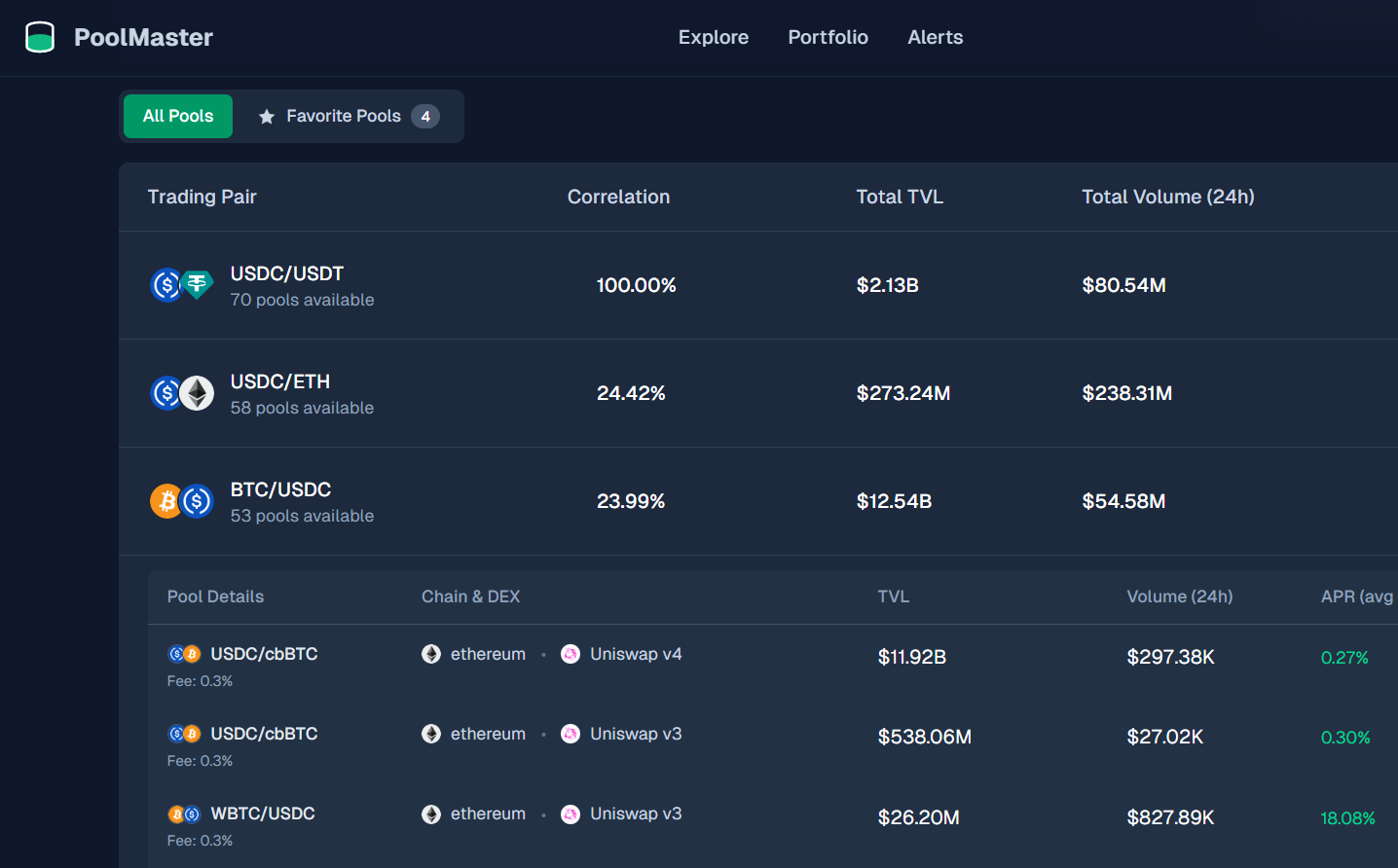
If you can't answer all three, you're not investing — you're gambling. On Poolmaster.io you can compare the same pair across different platforms and see which one has performed better historically, with real backtesting instead of projected APRs.
3rd. Reinvest the returns
Let compound interest do its magic. Reinvesting all or most of the profits will make your portfolio grow faster and exponentially.
It's the least flashy part of the strategy and, by far, the most important. A 15% annual return reinvested comfortably beats a 40% that gets withdrawn every month and spent.
What you'll find in this portfolio
We'll be publishing the moves, the pools we enter, the ranges we configure and the real results — including the ones that don't work out. The idea isn't to showcase a perfect portfolio, it's to show the reasoning behind each decision.
Because in the end, the difference between the 3% and the 97% isn't luck. It's method.
The portfolio is public: audit it yourself
You don't have to take our word for it, or trust a screenshot. The portfolio is 100% public and verifiable on-chain. This is the address:
0x261c0A482D2A83E1B3E67F0aa27dD5516B76Ec95
You can track it in real time here:
- DeBank — portfolio overview: total balance, open positions across every protocol, multichain at a glance. The fastest way to see how much there is and where it sits.
- Revert.finance — the liquidity position detail: configured ranges, accrued fees, impermanent loss and the real performance of each position. This is the view that matters when judging whether a pool is actually working.
Every move we publish on the blog will be reflected at that address. If at any point the numbers in an article don't match what you see on-chain, the chain is right.
Conclusion
Investing in liquidity pools doesn't have to be a lottery. With a conservative strategy, real data instead of projected APRs, and the discipline to reinvest, you can get realistic returns that hold up over time.
You're not going to get rich in three months. But you're not going to be part of the 97% either.
💡 Exclusive discount: If you want to try Poolmaster PRO, use the coupon
POOLMASTER_STARTERto get a 25% discount.
If you found this article useful, share it — there are a lot of people entering pools with no criteria beyond the biggest number on the screen.
No more Fake APRs. Get realistic APRs with our backtesting method.